Saturday, January 5, 2013

What Questions Should I Ask My Realtor When Buying Timberland?


When buying a recreational property, a good deal of the value could be in the standing timber. As a buyer you need to understand what you are buying such as type of timber (products), how much timber and value of the timber. If you are working with an agent, hopefully that agent can add value to your decision making process. With that in mind, here are several questions that recreational buyers should ask when they are learning about the timber on a recreational property:
Question: Does my agent understand timberland and the markets for timber?
Answer: If your agent doesn’t have experience understanding and explaining timber values, the agent should bring someone in to help who has that knowledge. Make sure your decision is based on accurate information. Otherwise, you may not pay an appropriate price. Make sure the valuation of the timber on a property is directly related to your property of interest. No two tracts are identical. 


Question: How can I have confidence in what I am buying from a timber perspective?
Answer: If the timber component of the property is a major reason for your purchase, it’s a good idea to be comfortable with the timber inventory on the property. Confidence comes from having a complete forest inventory, which will give estimates of acres in each timber stand, such as a 10-year-old pine plantation, 28-year-old pine plantation, streamside management zones, non-forested areas such as ponds, etc. The information should provide volumes by product classification such as pulpwood, sawtimber etc. Sometimes only a forest inventory or “timber cruise” is available and that is OK. Besides you will need these volumes and prices when doing cost allocation on the property. I wrote about this topic in an earlier blog… 


Question: How do I get a handle on how I might want to manage the property from a timber perspective?
Answer: To begin with you as the landowner must determine your objectives. Are you most interested in wildlife habitat, aesthetics or timber production.  A knowledgeable agent should be familiar with forest management practices and can get you in touch with a forestry management professional, such as an Association of Consulting Foresters (ACF) forester or a Registered Forester. To begin with you as the landowner must determine your objectives.  Based on your answers a forest management practitioner can help you outline a plan. Bare in mind, all these uses work very well together. For instance if you are interested in wildlife habitat, you might leave very large streamside management zones when planning a timber harvest.

Question: How can I figure out if I can expect to get cash flow from timber on a property?
Answer: It’s important to have quantifiable, realistic information and goals in regards to potential timber cash flows. This ties into setting your overall goals for the property. Planted pines are easy to cash flow. Your forester knows when each stand needs to be thinned and can determine approximate revenues.

For Information on Buying or Selling Land contact G. Kent Morris, ALC, RF at                          (706) 457-0090   

Thursday, December 20, 2012

What Do I Need To Know About Maintaining My Property Lines?


I sold a tract of land in Meriwether County this week and the buyer asked me about a survey. We had a very old survey and the boundary lines had once been painted by a timber company. I worked out a fee for service arrangement and painted the property lines. I decided this might be a good topic to blog. Maintaining property lines and boundaries is one of the most often overlooked forms of protection from timber theft, trespass, and encroachment.  I recommend having the property lines painted every 5 – 8 years. You might also consider putting up ‘posted’ signs as well. Survey work can be very expensive so a good boundary line program can actually save you money and other problems as well. We’ll discuss these as well. 


Farmers and ranchers generally use barbed wire (also referenced to as devil wire) fences. If you own a wooded tract or a large number of acres, this is not practical. Maintaining your property lines  is imperative when undertaking a timber harvest.  It also can be helpful if there are any trespass issues.  Knowing where your property is located on the face of the earth can go a long way for a landowner’s peace of mind. Frequent maintain can help ward off an adverse possession claim.  Adverse possession A method of gaining legal title to real property by the actual, open, hostile, and continuous possession of it to the exclusion of its true owner for the period prescribed by state law.


 If your property has been previously marked out, simply go out and “refresh” the lines.  The most common practice is to blaze the tree bark. I generally use a machete to blaze the tree and shave the bark creating a smooth surface to paint.  With all the effort involved make sure you use a quality paint. Companies like Forestry Suppliers and Ben Meadows sell this type of paint. Flagging simply won’t work and the flagging  deteriorates  after a year or two. Fall, winter and early spring seem to work best. The foliage is gone and the nice weather is conducive to more work.

For Information on Buying or Selling Land contact  G. Kent Morris,  ALC,  RF  at         (706) 457-0090

Saturday, December 1, 2012

What features or attributes are the most desirable for the Land Buyer?


LandThink conducted a survey in 2012 of professional land brokers that I participated in.  They ask the question… In your opinion, what is the most desirable feature that people require when searching for land? The results are in.


  • 38.2% said a WATER FEATURE (creek, river, pond, lake, etc.) was most desirable
  • 22.8% said ROAD FRONTAGE was most desirable
  • 11.8% said MUNICIPAL or WELL WATER was most desirable
  • 11.2% said ELECTRICITY was most desirable
  • 7.1% said an INTERNAL ROAD SYSTEM was most desirable
  • 4.1% said a DWELLING or CABIN was most desirable
  • 2.1% said STRUCTURES or BARN was most desirable
  • 1.5% said WILDLIFE IMPROVEMENTS (food plots, deer stands, etc.) was most desirable
  • 1.2% said FENCING and GATES were most desirable
For Information on Buying or Selling Land contact G. Kent Morris, ALC, RF at      (706) 457-0090

Monday, November 12, 2012

What is an appraisal and how do I determine what my property is worth?


This is a great subject and dear to my heart. I have 4 appraiser friends and this topic comes up frequently. A real estate appraisal is an important component of the overall real estate transaction. The value determined is often used for financing.  There are three primary types of real estate appraisals that may be used, including the "cost approach," the "sales comparison approach," and the "income capitalization approach."
The "cost approach"  This method in simple terms determines the cost to replace the asset. It is determined by adding cost of materials, labor etc and is often used on unique property like churches etc.
The "sales comparison" This approach compares the price per unit area of similar properties  (or prices per acre) in the surrounding area. For example, a potential buyer will be presented with a full listing of properties that are similar in features, sales prices, including a comparison to their own property explaining the overall appraisal value. The price variations are generally averaged to create a fair market value for the property being appraised. This type of real estate appraisal is considered to be the most accurate appraisal as it utilizes recent market values on comparable properties.
The "income capitalization approach" to real estate appraisal is also commonly referred to as the "income approach" and is mostly used for commercial properties, not residential.  Most commercial real estate investors are interested and relying on the income possibilities or past income performance data when deciding to purchase a property. This type of appraisal is more technical and often lengthier than residential appraisals.


Now, how does this apply to land? Comparable sales appraisals are deeply flawed in the area of rural real estate. This method works well in an urban setting. You look at a subdivision built out in two years, compare 3 or 4 houses that sold over the last 6 months and there you go! However, the entire real estate industry seems to blindly follow this method because it’s the standard. How do you find good comps on rural land? I am not sure you can. No two properties are identical. One has a little field, one has established food plots, one has pine the other has hardwoods, one has 50 year old timber, the other has 20 year old timber. How do you put value on a creek? pond? road access and road surface? The list goes on and on. Sales seem to be more infrequent with rural land sales and therefore comparable sales have limited value.

In my judgment a combination approach should be taken. Land has production capacity which can be measured on timberland and agricultural land. The productivity of the property should impact value. In some cases the ‘highest and best use’ should be taken into account depending on proximity to growth corridors and utilities. One might have to use the comp approach on the land and add the value (cost value) of improvements such as barns, fencing and ponds. We might call this a hybrid approach and in my opinion, this should be the approach to appraising rural property!


For Information on Buying or Selling Land contact G. Kent Morris, ALC, RF at      (706) 457-0090

Tuesday, October 23, 2012

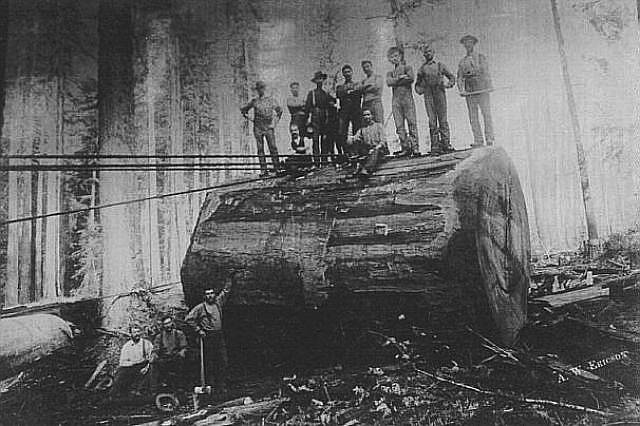
BIG TREES.... a bygone era!

   I usually write informational blogs but decided to do a fun blog. Many of you know I am a Registered Forester. I grew up camping in the Appalachian mountains with my family and that is why I possibly went into forestry. I have always been interested in logging pictures and big trees. As a matter of fact many of the roads in the Appalachians were originally  railroads constructed by the logging and sawmill industry. Following are some pictures I have acquired over many years. 


   I am thankful that many of the big trees are now being preserved but certain trees like genetically improved Loblolly are meant to be cut and used for lumber and paper products. A forester friend sent me an email with the following.......Notice: It's OK to print this e-mail.  Paper is a plentiful, biodegradable, renewable, recyclable, sustainable product made from trees.  Producing paper and other forest products utilizes a renewable natural resource, sequesters additional carbon and provides jobs and income for millions of Americans."

For Information on Buying or Selling Land contact G. Kent Morris, ALC, RF at          (706) 457-0090